Short answer: industry data shows the large majority of restaurants have now moved to digital menus, and that share keeps growing every year (QR code usage statistics, 2026). In other words, a QR menu is no longer just something big chains do — it's become a day-to-day need for a single-location café down the street too.
In this guide, we cover the three concrete problems that have turned QR menus from "a nice-to-have novelty" into a practical necessity for restaurants and cafés — and how a QR menu solves each one.
What Three Problems Can't a Printed Menu Solve?
Printed menus have worked for decades, but they struggle badly in three specific areas: mobile readability, the cost of updating prices and stock, and digital first impressions. These three are becoming an increasingly serious disadvantage, especially for small and mid-sized businesses working with limited budgets.
A PDF menu shared on Google Drive, or an old, worn-out printed one, delivers an experience that has to be pinch-zoomed on a phone and loads slowly — creating an unexpected weak point in a brand's first impression.
Why Does Changing a Price Get So Expensive?
When a price changes on a printed menu, you're left with two options: cross it out by hand (which makes the brand look careless) or pay for a new print run and wait days for it. During periods of high inflation, this cycle can repeat more than once a month.
How Exactly Does a QR Menu Solve These Problems?
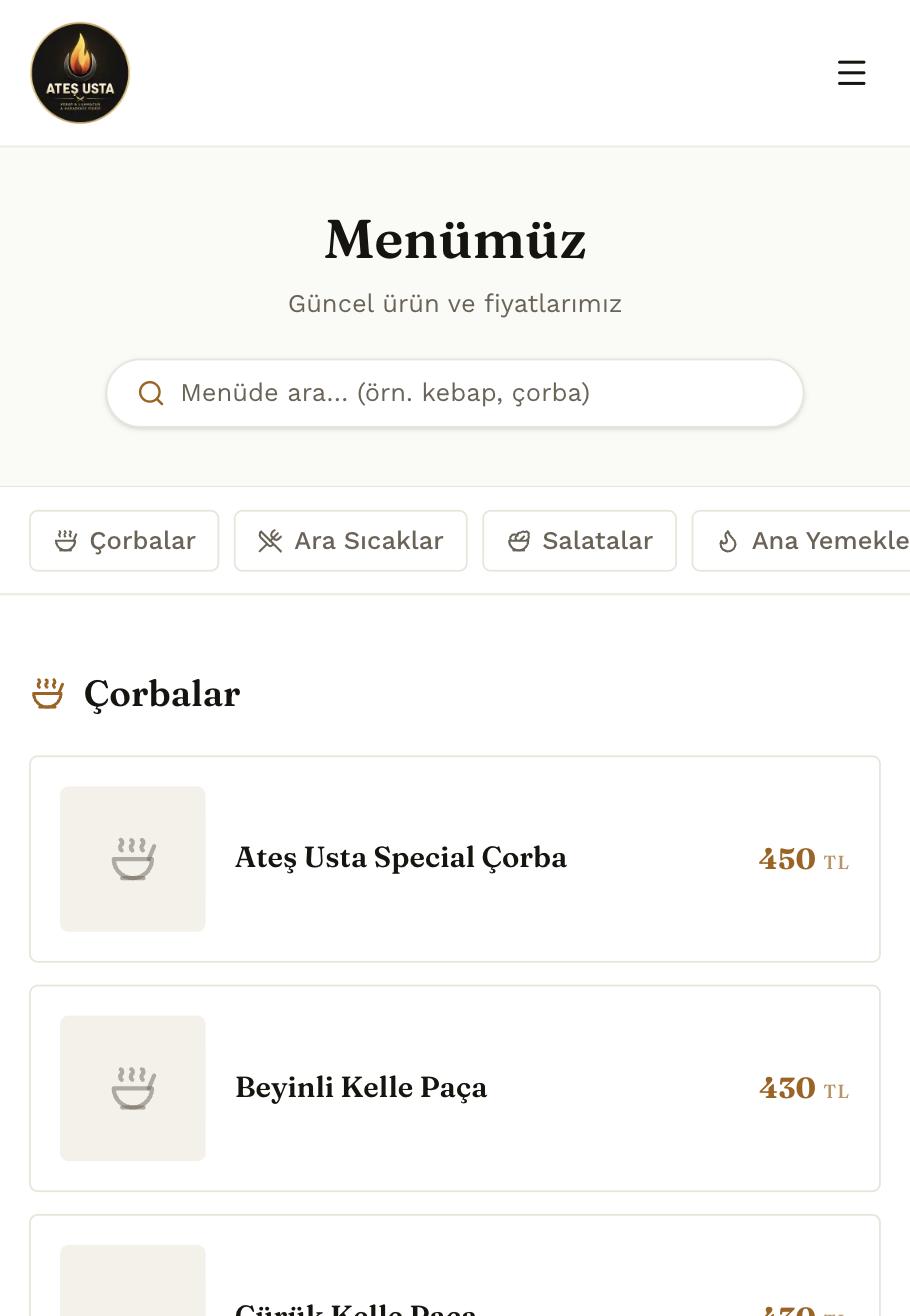
A QR menu opens instantly when a guest scans the code with their phone camera, offering category tabs and live search on a mobile-friendly menu — no download, no app, no waiting. When a price or stock level changes, the update happens in seconds through an admin panel, with no need for a new print run.
This is essentially custom software and automation logic applied to the restaurant and café industry: turning a repetitive, manual task (menu printing) into something a system, set up once, handles automatically.
What Does a QR Menu Mean for a Business With No Ad Budget?
For a restaurant or café with no budget for Google or Meta ads, giving every guest who sits down at a table a flawless digital first impression is an investment that requires no budget at all, yet still makes a real impact. Every visitor coming from social media, or walking in directly, meets a professional experience.
A QR menu is a quiet but effective digital investment — one that doesn't need a big ad budget, yet still makes a real difference to every guest at the table.
Why Vinci Studio?
When we build a QR menu system, our goal isn't just to digitize the menu — it's to give the business owner a genuine control panel. What sets us apart in our Renaissance-spirited approach to digital production:
- Update prices, stock, and product order in seconds from an admin panel
- A mobile-flawless menu design with category tabs and live search
- Performance proven on real, live projects (Ateş Usta and Paşam Lounge)
- An approach built for making a strong digital first impression even on a limited budget
How Does a QR Menu Make a Real Difference on Real Projects?
On the Ateş Usta project, where we supported physical menu boards with a digital QR menu, the core motivation was making price updates easier; now, when a product's price changes, the team can update it in seconds from the panel, with no need to wait for a new print run.
Paşam Lounge was a different situation: the business had no corporate website yet, its social media accounts were newly launched, and its ad budget was limited. Under those constraints, investing in a QR menu system first stood out as the most concrete, fastest way to make an impact with limited resources.
A shared observation across both projects: guests using the category tabs and search feature found what they wanted much faster, which improved both guest satisfaction and the speed of the ordering process.
How Much Difference Does Admin-Panel Editing Really Make?
Removing a seasonal item from the menu, adding a new promotional product, or temporarily hiding something that's sold out — all of this used to either get scribbled by hand onto the menu or wait for the next print run. Now, these changes can be made the same day, sometimes the same hour.
This flexibility is a serious advantage for short-lived campaigns in particular, like a weekend special or a deal of the day; these kinds of short-term changes were practically impossible with a printed menu.
What Does This Flexibility Look Like in Practice?
A business owner spotting a pricing mistake at breakfast and fixing it before the lunch rush — during the printed-menu era, that kind of correction could take days.
Points to clarify before switching to a QR menu system:
- How often does the menu actually change? The frequency of price/stock changes directly affects how much benefit a QR menu delivers.
- Will the physical menu be fully replaced, or will the QR menu supplement it? Both approaches are valid, depending on the need.
- Is the category structure and are product images ready? This directly affects how good the QR menu looks on mobile.
- How will QR codes be placed on tables? Options range from table-top stands to menu cards to surface stickers.
A business that clarifies these questions upfront can complete the switch to a QR menu smoothly and quickly.
Common Mistakes
The most common mistakes restaurants and cafés make when switching to a QR menu:
- Placing the QR code somewhere too small or hard to notice on the table
- Failing to keep menu categories and product images up to date
- Launching the QR menu without ever testing it on mobile
- Skipping admin panel training and leaving every update to the agency
- Never testing menu speed in a location with weak Wi-Fi
How Should This Process Differ for Small, Single-Location Businesses?
Unlike large chains, a single-location café or restaurant doesn't need a complex integration; the priority is a simple, fast-loading, easily updated system. Unnecessary complexity can turn into a burden rather than a benefit for a small business.
What Does This Difference Look Like in Practice?
For a single-location business, an admin panel that the owner can learn and use in a few minutes, with no separate technical team required — that's the single most critical factor in whether the system actually gets used day to day.
Who Will Benefit Most From This Guide?
For restaurants and cafés with frequently changing prices, tired of the cost of printed menus, a QR menu offers a directly applicable solution.
For newly opened businesses with no corporate website yet and a limited ad budget, investing in a QR menu first is often the fastest way to make a concrete difference with limited resources.
- Restaurants and cafés with frequent price/stock changes
- Newly opened businesses without a corporate website yet
- Businesses with a limited ad budget looking to make an impact with limited investment
Conclusion: Take Action Now
Would you like to digitize your restaurant or café with a QR menu? At Vinci Studio, we listen to your needs, map out a roadmap tailored to you, and report transparently throughout the process. Get in touch with us or send your request in seconds using the "Get a Quote" button on the homepage.